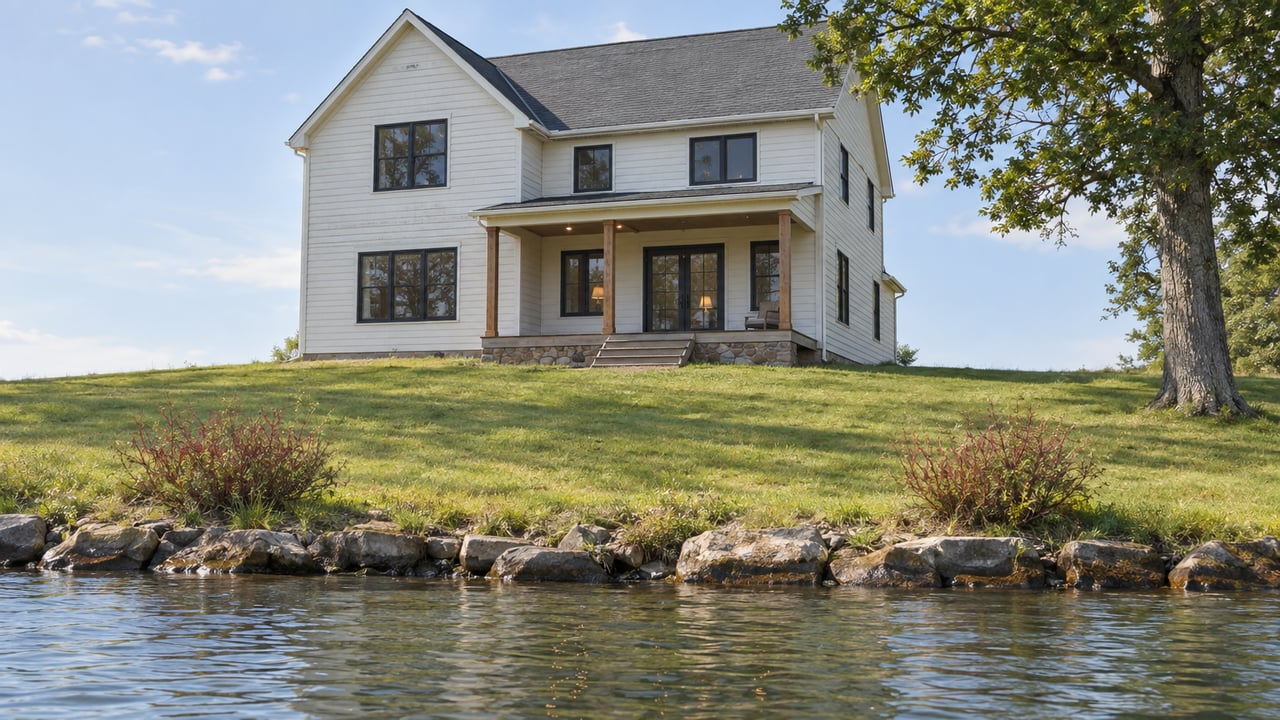
Most Holland lakefront offers get built around two numbers: the list price and the water frontage. Those two numbers tell a buyer almost nothing about three things that actually determine what the purchase includes. Whether the parcel carries real water rights or shared access. Whether a future dock repair or seawall replacement needs state sign-off before a contractor can start. Whether the home sits on the Ottawa County or Allegan County side of a line that runs straight through Holland's own zip code.
None of that shows up in a listing photo. Some of it doesn't show up in the paperwork buyers assume covers everything, either. Michigan's Seller's Disclosure Statement is a real legal document with real teeth, but it was written to describe a house, not a shoreline. Knowing where its coverage stops is the difference between a smooth closing and a surprise six months in.
What the Disclosure Form Actually Covers
Michigan's Seller Disclosure Act requires a seller to hand over a written disclosure statement before a purchase agreement becomes binding, or within 72 hours after acceptance if timing runs tight. The form itself asks about specific systems: whether there's been water in the basement or crawl space, the age and condition of the roof, the well's depth and testing history, the septic tank and drain field, the plumbing type, the heating system. If a home was built before 1978, federal lead paint disclosure rules layer on top.
The form is based on what the seller actually knows, not on an inspection they're required to perform. A seller can mark an item unknown and stay compliant. That's by design. The statement exists to prevent a seller from hiding a known problem, not to certify the property the way an inspector or appraiser would.
That scope matters because it draws a boundary. Everything inside that boundary, the mechanical bones of the house, is something a buyer can expect a seller to address on paper. Everything outside it is something the buyer has to go find on their own.
The Word "Waterfront" Covers More Than One Arrangement
Holland's shoreline isn't one uniform product. Macatawa Hills, on the south side of the city, sits close enough to both Lake Michigan and Lake Macatawa that some local listings describe it as the Cape Cod of the Midwest. Castle Park borders the Lake Michigan shoreline near there and carries its own long local history. Park Township, on the north side, holds Holland State Park and the Big Red Lighthouse, with the Tunnel Park corridor a short drive further north. All of it gets marketed under the word "waterfront." Not all of it conveys the same rights.
A parcel with direct frontage typically carries riparian rights, meaning the owner's rights extend to the water itself. A parcel with deeded access might only grant use of a shared path or a piece of beach owned collectively with neighbors. A home near a public beach like Tunnel Park offers easy recreational access but creates no private ownership claim at all. These are legally distinct arrangements that can look identical from a listing photo of a dock and a sunset.
The disclosure form doesn't ask a seller to characterize any of this. It's not a gap in the law so much as a gap in what the law was built to cover. The document that actually answers the access question is the survey, the deed, the title commitment, and any lake association or homeowners association paperwork attached to the parcel. A buyer working through those documents before closing is doing work the standard disclosure was never designed to do. Skipping that step is how someone ends up owning a house with a lake view and someone else's name on the dock easement.
A Permit You May Need Before You Touch the Shore
Buyers on Lake Michigan frontage sometimes assume that owning the shoreline means they can maintain it however and whenever they choose. Michigan's shoreline permitting rules say otherwise, and the rules apply with more reach than most buyers expect.
The state's High-Risk Erosion Area program, run through the Michigan Department of Environment, Great Lakes and Energy, designates stretches of Great Lakes shoreline where the long-term recession rate has run at least one foot per year over a 15-year period. Within a designated area, a permit is required for construction on any part of the parcel, not just the section closest to the water. A house addition, a garage, a new septic system, even a covered porch set well back from the bluff can trigger the requirement. The state sets two setback distances for new construction, one calculated for a 30-year horizon and one for 60 years, based on how fast that particular stretch of shoreline has historically receded.
Distance from the water doesn't exempt a project from review once a parcel falls inside one of these zones. That single fact changes how a buyer should think about renovation budgets and timelines on lakefront property, because permit review adds weeks that a landlocked remodel never has to account for.
None of this shows up on the standard disclosure form either. A seller who has never needed a permit has nothing to disclose. A buyer planning future shoreline work needs to check the state's erosion area maps directly, separate from anything the transaction paperwork requires.
Two Sides of a County Line
Holland's own zip code, 49423, spans both Ottawa County and Allegan County. That line isn't just a mapping curiosity. It changes which equalization department sets a home's assessed value and which school district's operating millage applies to the tax bill.
On the Allegan County side of Holland, the effective property tax rate runs close to 0.99%, based on the county equalization department's own reporting. School operating millage adds another layer that varies by district rather than by county line. For the 2026 tax levy, the Holland school district asked voters to renew a millage rate capped at 19.2523 mills, while Zeeland Public Schools, which also serves part of the Holland area, carried a renewed cap of 18.6727 mills. A buyer comparing two similarly priced homes a few blocks apart, one inside Holland Public Schools and one inside Zeeland, is comparing two different tax exposures even before either county's equalization process gets involved.
None of that is a red flag. It's simply a variable that a listing price never carries on its face, and one worth confirming through the county assessor before a final offer rather than after the first tax bill arrives.
The Closing Costs the Sticker Price Doesn't Show
Lakefront and rural parcels around Holland tend to carry a specific set of closing costs that a downtown condo purchase doesn't. Buyers moving from an all-city-utility purchase to a well-and-septic property should expect these line items on top of standard lender fees.
| Line item | Typical range |
|---|---|
| Septic inspection | $250 to $600 |
| Well water test | $100 to $300 |
| Property survey | $300 to $1,000 or more |
| Elevation certificate or flood documentation | Several hundred dollars, cost varies |
Flood documentation deserves its own line because Lake Michigan frontage often requires flood insurance as a lender condition, and premiums vary enough that a quote should be in hand before an offer is finalized, not after. A buyer budgeting only for the down payment and standard closing costs on a Holland lakefront purchase is usually underestimating by a few thousand dollars once these inspections and reports are added in.
Common Questions From Holland Lakefront Buyers
Does the seller have to tell me if the property is in a High-Risk Erosion Area? Only if they know and it comes up under the general disclosure of known material conditions. The form has no dedicated line item for erosion zone status. Checking the state's mapping tool directly is the more reliable route.
If I want to replace an existing seawall, do I still need a permit? Often yes. Seawall replacement can qualify for an expedited review in some cases, but the project still typically requires state approval before work begins, separate from any local building permit.
Does "waterfront" always mean I own the lake bottom? Not necessarily. Ownership rights, known as riparian rights, generally require direct frontage. Deeded access to a shared beach or path is a different legal arrangement and should be confirmed through the survey and title work rather than assumed from the listing description.
Buying on Holland's shoreline means signing paperwork about a house and separately doing the work of understanding the water rights, the permitting rules, and the tax lines that come with it. Ryan Prichard's background in banking and mortgage lending, paired with the team's work across Holland's waterfront neighborhoods, means those pieces get walked through before an offer goes in rather than discovered after closing. If you're comparing specific Holland lakefront listings and want a second set of eyes on the paperwork behind the view, reach out to Prichard Properties and we'll go through it together.
